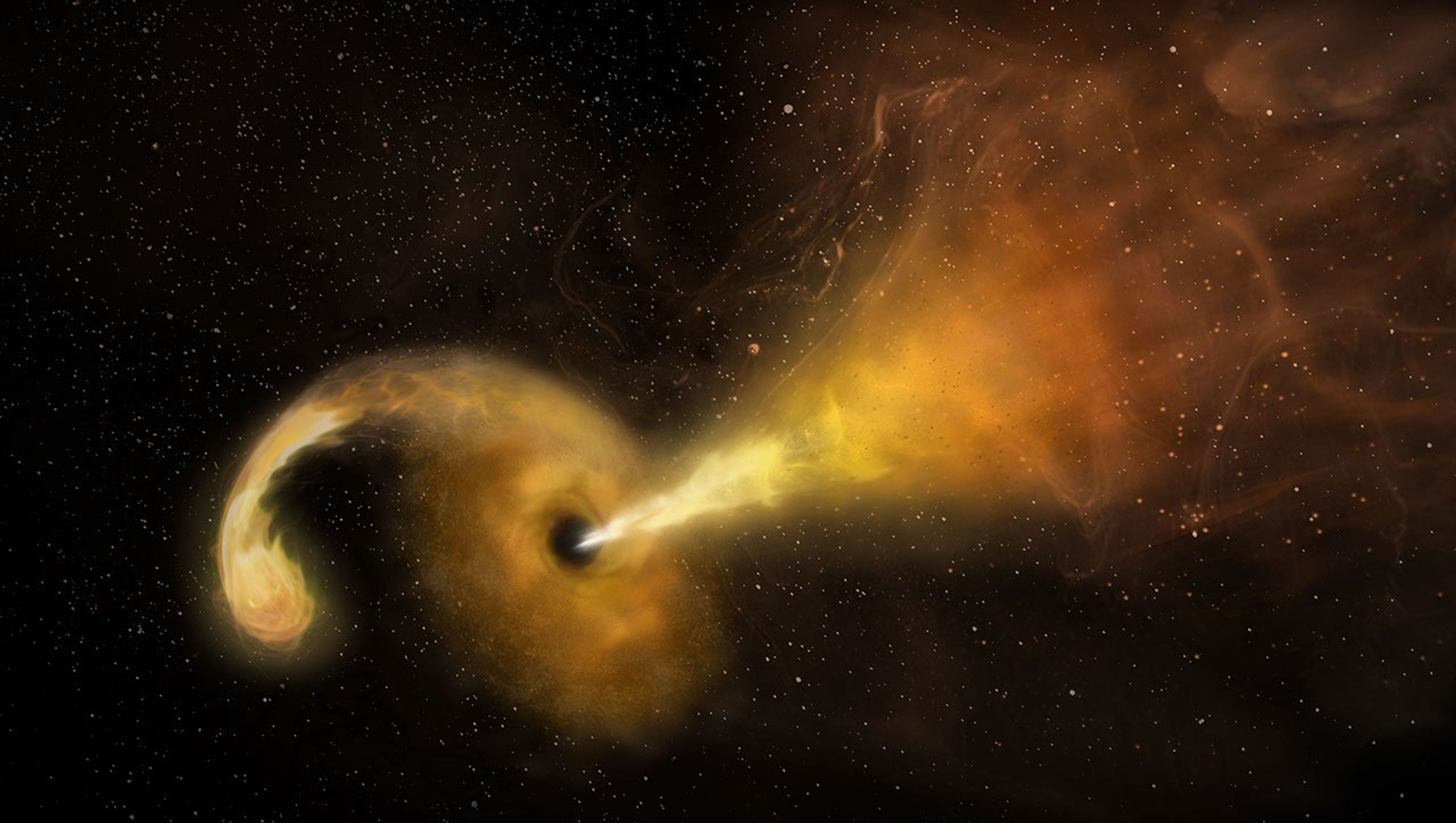
NASA's Swift Sees 'Wandering' Mega Black Hole Shredding Star
NASA's Swift Observatory captured an "orphan" black hole devouring a star on the outskirts of a faraway galaxy, a rare phenomenon observed outside the galaxy's core.
NASA's Swift Observatory captured an "orphan" black hole devouring a star on the outskirts of a faraway galaxy, a rare phenomenon observed outside the galaxy's core.
NASA’s Neil Gehrels Swift Observatory captured an “orphan” black hole lighting up as it devoured a star on the outskirts of a faraway galaxy. These phenomena are rare to begin with, and none had ever before been seen so far outside of a galaxy’s core. “We were looking for these star-shredding events as a way […] NASA’s Neil Gehrels Swift Observatory captured an “orphan” black hole lighting up as it devoured a star on the outskirts of a faraway galaxy. These phenomena are rare to begin with, and none had ever before been seen so far outside of a galaxy’s core. “We were looking for these star-sh.
NASA's Swift Observatory has captured an image of a massive black hole shredding a star in a distant galaxy. The black hole, which is estimated to be 10 million times more massive than the sun, is located in the outskirts of a faraway galaxy. The image, which was captured by the Swift Observatory's X-ray telescope, shows the black hole's intense radiation as it tears apart the star. This phenomenon is known as a tidal disruption event, where the black hole's gravity overpowers the star's gravity, causing it to break apart. The event is a rare occurrence, and scientists are eager to study it further to learn more about black holes and their behavior.